
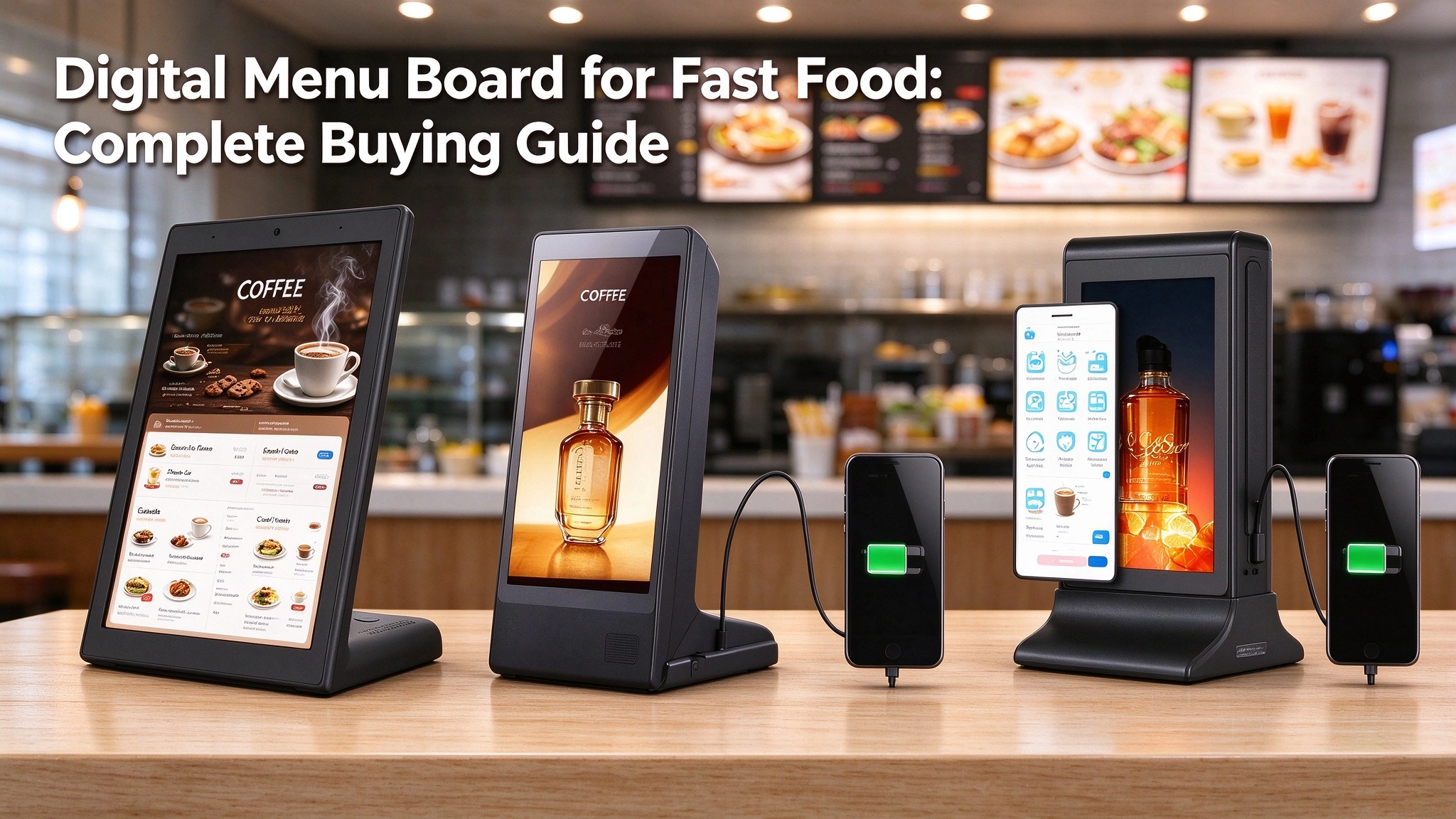
Fast food and quick-service dining rely on speed, clear ordering, and efficient upselling. Every second a customer spends squinting at a messy menu slows your queue and limits sales potential. That is why digital menu boards have become one of the most practical forms of digital signage for counter-service food businesses. Unlike printed static posters, digital menu boards update remotely, highlight promotions automatically, and guide customers toward higher-value combos.
While large wall-mounted menu screens are widely used for back-of-counter displays, compact L-shaped desktop menu machines have emerged as a popular option for small counters, kiosks, bubble tea shops, snack bars and compact fast-food outlets. This buying guide covers everything fast-food operators need to know when shopping for digital menu boards, with a special focus on small-form L-type desktop models.
Why Fast Food Operators Choose Digital Signage for Menus
Digital signage solves many pain points that plague restaurants relying on printed menus. Static paper menus require reprinting every time prices change, seasonal items launch or limited-time deals expire. The printing cost, lead time and waste add up month after month. Digital menu boards eliminate that recurring expense, while adding powerful merchandising functions.
With digital signage, restaurant owners can schedule content to switch automatically: breakfast menus in the morning, lunch combos at noon, late-night specials after dinner rush. You can highlight high-margin drinks, side dishes and bundle offers, use subtle visual prompts to encourage add-on sales, and keep your menu information accurate at all times. Customer surveys consistently show that fast-food locations using digital menu boards enjoy faster order times and higher average order values compared with static printed alternatives.
For venues with limited counter space, oversized wall screens are not always the right fit. This is where small L-shaped desktop digital menu boards shine. These compact digital signage units sit right at the ordering counter, face customers directly, and fit neatly into tight counter layouts that cannot accommodate large wall-mounted panels.
Key Specs to Know for L-Shaped Desktop Menu Machines
The L-type desktop menu machine is our featured compact digital menu solution, built specifically for countertop ordering scenarios. It focuses on small mainstream sizes: 8 inch, 10.1 inch and 13.3 inch, which strike the perfect balance between visibility and space efficiency. When selecting this style of digital menu board, there are four core options you need to consider: screen side type and power configuration.
1. Single-sided vs Double-sided L-shaped menu display
- Single-sided model: One commercial-grade display facing the customer. This is the most cost-effective choice for standard counters where only guests standing in line need to view the menu. It is lightweight, simple to install, and ideal for bubble tea shops, small burger stalls and grab-and-go snack stores.
- Double-sided model: Screens on both sides of the L-shaped stand. This variant works brilliantly for counters positioned in walkways, or when you want to show menus to both the ordering customer and people waiting behind them. It is also widely used in food courts where foot traffic approaches the counter from multiple directions.
2. Battery-powered version vs Non-battery (plug-in) version
- Non-battery (plug-in): Continuous 24/7 operation via power adapter. This is the stable, low-maintenance pick for counters with easy access to power sockets. It is the standard selection for stores that run long daily hours, with no need to move the screen frequently.
- Built-in battery version: Rechargeable battery inside the unit. This flexible option lets you move the L-shaped menu machine freely around your store without trailing power cords. You can shift it between the ordering counter, pickup zone or pop-up stall, and it keeps running for hours after charging. It is perfect for food pop-ups, mobile catering, or counters where power outlets are inconvenient.
The 8-inch size works best for very narrow counters or secondary pickup-point menu displays. 10.1 inch is the most universal seller for small fast-food shops and cafes. The 13.3-inch variant offers larger text and food imagery while still remaining compact enough for constrained counter space.
Other Critical Buying Criteria for Fast-Food Digital Menu Boards
Beyond the form factor of the L-shaped desktop unit, evaluate these core features no matter which style of digital signage you select:
Brightness (Nit Rating)
Brightness determines readability under indoor lighting or near windows. For indoor countertop use, 400–700 nits is sufficient for most L-type desktop menu machines. If your counter sits next to large windows with strong natural light, prioritize the higher brightness tier to avoid washed-out, hard-to-read screens. Wall-mounted menu screens for bright front-of-store areas usually require higher brightness ratings of 1500 nits or above.
Content Management System
The biggest advantage of digital signage is remote content control. Confirm the menu board supports simple cloud CMS software. Your staff should be able to edit prices, swap food photos, build combo promotions and schedule timed content without advanced technical skills. The best systems support bulk updates, so you can push identical promotions to multiple menu screens across your store at once.
Commercial-Grade Hardware
Avoid consumer TVs repurposed as menu boards. True digital signage hardware is engineered for long daily running hours, stable performance, and continuous operation. L-shaped desktop menu machines are built with slim commercial panels that run reliably all day, unlike household screens which can overheat and degrade rapidly with prolonged use.
Mounting and Placement Planning
Plan your placement before purchase:
- Small 8/10.1/13.3 inch L-shaped desktop menu machine: sit directly on the ordering counter, eye level for customers, no wall drilling required.
- Wall-mounted menu screen: fixed above the counter for high-volume stores with enough wall space.
- Double-sided battery L-type unit: flexible placement for food court stalls and pop-up events.
Common Mistakes to Avoid When Buying Fast Food Digital Menu Boards
- Buying an oversized screen for a tiny counter. A large wall display will clutter compact ordering zones; the 8–13.3 inch L-shaped desktop digital signage is purpose-built for limited counter space.
- Picking the wrong power option. If you never move the unit and have power nearby, plug-in non-battery models are more stable. If mobility is required, invest in the built-in battery variant.
- Ignoring single vs double-sided needs. A single-sided screen wastes opportunity if customers approach your counter from two directions, while double-sided units add unnecessary cost for simple single-line counters.
- Overcrowding the screen layout. Small L-type menu displays have limited pixel space. Keep menus concise, feature 3–5 core highlighted items per screen view, and use clean typography so customers read quickly.
- Choosing low-brightness panels for sunlit counters. Glare will make your digital menu board unreadable and defeat the purpose of digital signage.
Budget Overview
L-shaped desktop digital menu boards are among the most affordable commercial digital signage options for fast food, thanks to their compact 8, 10.1 and 13.3-inch sizes. Single-sided plug-in units are the entry-level budget choice. Double-sided and battery-integrated versions carry a moderate price premium for the extra screen and power module. Wall-mounted large-format menu screens have a higher price point, suited for bigger restaurant layouts.
When calculating ROI, factor in eliminated print costs plus incremental sales from upsell promotions. Most compact menu signage for small fast-food locations delivers positive returns within months.
Frequently Asked Questions
Does a digital menu board increase fast food sales? Yes. Digital signage lets you feature high-margin combos and limited-time offers, speeding customer decisions and lifting average order value compared with static printed menus.
What sizes are available for L-shaped desktop menu machines? Our L-type desktop menu machines focus on small sizes: 8 inch, 10.1 inch and 13.3 inch, with single-sided or double-sided options, and versions with built-in battery or fixed plug-in power supply.
Should I pick battery or plug-in L-shaped menu display? Choose plug-in non-battery models for permanent counter placement with easy power access. Select the battery-powered variant if you need to move the display around for pop-ups, catering or flexible store layouts.
Is double-sided worth it for my fast-food counter? Double-sided L-shaped digital menu boards are ideal for food courts, aisle counters and locations where customers view the menu from two directions. Single-sided is enough for standard one-way ordering lines.
Can I update content on small L-shaped desktop digital signage easily? Yes. These compact digital menu boards use cloud-based CMS. You can edit menus, prices and promotions remotely from a phone or computer.
Final Verdict
Digital menu boards are a smart upgrade for nearly all fast-food businesses. For compact counters, bubble tea shops, snack stalls and food court vendors, the small L-shaped desktop menu machine is an outstanding digital signage solution. With flexible size choices of 8 inch, 10.1 inch and 13.3 inch, you can select single-sided or double-sided panels, and opt for battery-powered mobility or stable plug-in operation based on your store layout.
If you are ready to add compact countertop menu displays or larger wall-mounted menu screens to your restaurant, you can explore our full lineup of digital signage hardware, including our L-shaped desktop menu machines with multiple size and configuration options, in our product catalog at https://sundekdisplay.com/product/