
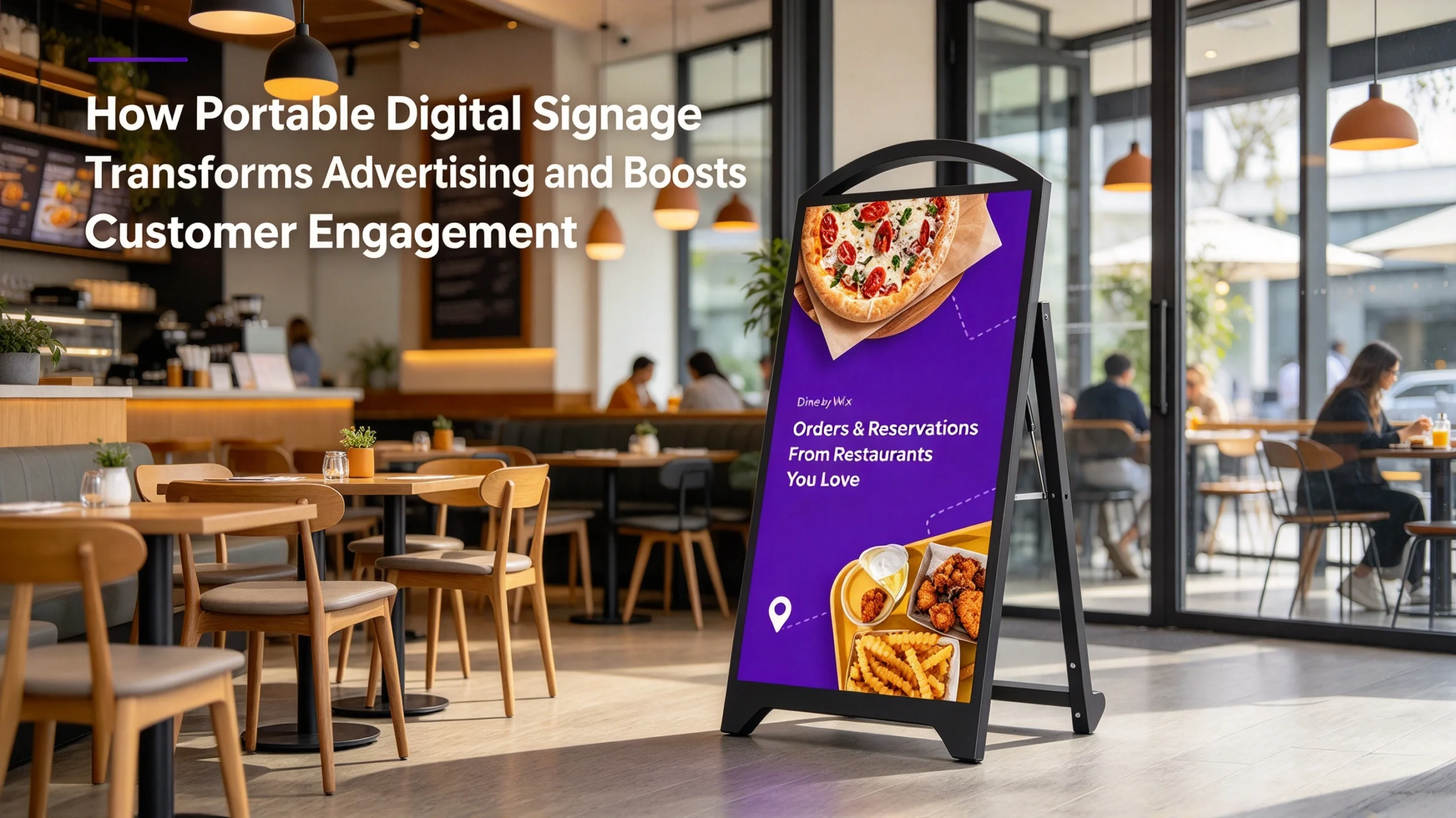
Walk into almost any successful retail store, restaurant, or trade show today, and you will notice one thing: screens. Big ones, small ones, ones that hang from the ceiling, and ones that sit right on the checkout counter. Among all of them, portable digital signage has quietly become one of the most flexible and cost-effective tools in modern advertising.
Unlike expensive, permanent LED billboards or fixed in-store displays, a portable screen can go anywhere your customers go. It moves with your campaign, adapts to your foot traffic, and delivers the right message at the right moment. In this article, we will break down exactly how portable digital signage works, why it outperforms traditional static advertising, and how you can use it to drive real, measurable customer engagement.
Why Traditional Advertising Is Losing Its Edge
For decades, businesses relied on printed posters, paper menus, and static window displays. The problem is simple: static content goes stale. A poster cannot update itself at noon to advertise the lunch special, and a printed banner cannot suddenly start promoting a flash sale at 3 PM.
Today’s customers are bombarded with thousands of advertising messages every day. To cut through the noise, you need content that changes, grabs attention, and feels relevant. This is exactly where digital display advertising wins. Screens capture attention at rates far higher than print, and they allow you to rotate offers, videos, and social feeds without printing a single new poster.
What Makes Portable Digital Signage Different
Before we dive into strategy, let us clarify what makes a display “portable.” A portable sign is a self-contained unit with its own stand, battery or power supply, and easy setup. You can wheel it to the storefront in the morning, move it to the event hall in the afternoon, and store it in the back office at night.
This mobility unlocks advertising use cases that permanent screens simply cannot serve:
- Pop-up stores and markets where you have no fixed infrastructure
- Trade shows and exhibitions where every square meter of booth space matters
- Outdoor promotions near entrances, sidewalks, or parking areas
- Seasonal campaigns that only need a screen for a few weeks
- Restaurant patios and café terraces that change layout seasonally
Because the screen is portable, your advertising strategy stays agile. You test a message in one location, measure the response, and move it where it performs best.
Portable Digital Signage for Retail: Driving Foot Traffic
Retail is where portable digital signage delivers some of its biggest wins. The average shopper decides within seconds whether to enter a store. A dynamic screen outside your door can be the difference between a passerby and a paying customer.
1. Window and Doorway Engagement
Placing a portable screen near your entrance lets you display eye-catching promotions without renovating your storefront. You can show customer reviews, behind-the-scenes videos, or a countdown to your next sale. This form of in-store advertising extends your brand presence right to the street, where the first impression happens.
2. Highlighting Impulse Items
Inside the store, a portable display near the checkout can rotate offers on snacks, accessories, or add-ons. Because the content updates instantly, you can pair the screen with your point of sale strategy and promote the items with the highest margin at that exact moment.
3. Interactive Experiences
Many portable displays support touch input. An interactive display lets shoppers browse a catalog, check a product’s specifications, or scan a QR code to receive a coupon. This turns a passive viewer into an active participant—one of the strongest drivers of genuine engagement.
Digital Menu Boards and the Restaurant Opportunity
For restaurants and cafés, portable digital signage is a game changer. A static menu cannot respond to the time of day, but a digital menu board can.
Imagine a café that shows breakfast deals until 11 AM, then switches to lunch combos, then highlights happy-hour drinks in the evening. All of this happens automatically. Portable screens let you run this playbook even if you have no wall space or a fixed mounting point.
Menus are not the only use case. Restaurants can use portable displays for:
- Order-confirmation screens at pickup counters
- Upsell prompts for desserts and sides
- Social media walls that display live customer posts
- Wait-time information that keeps customers calm and informed
The result is smoother operations and customers who feel the brand is modern and attentive.
Trade Shows, Events, and Outdoor Promotions
If you have ever exhibited at a trade show, you know the challenge: your booth has seconds to earn attention. Portable digital signage gives you a massive visual advantage in that race.
Booth Presence
A moving screen with looping product videos, testimonials, and key stats does more than a static banner can ever hope to achieve. It draws attendees in, and because the display is portable, you can reposition it to face the heaviest foot traffic as the show evolves.
Wayfinding and Information
At large events, portable displays serve as digital wayfinding tools. You can show session schedules, speaker bios, floor maps, and sponsor messages. This kind of event marketing adds value for attendees while keeping your brand visible throughout the venue.
Outdoor Visibility
For outdoor use, choose a weather-resistant portable model. An LED screen advertising solution with high brightness remains readable even in direct sunlight. Whether you are promoting a grand opening, a sidewalk sale, or a community festival, a bright outdoor screen commands attention that print flyers simply cannot match.
The Psychology Behind Higher Engagement
Why does portable digital signage work so well at engaging customers? The answer lies in attention science.
Human vision is naturally drawn to motion. Movement in the peripheral vision triggers an orienting response—our eyes turn toward it automatically. This is why video content on a screen outperforms static posters almost every time. Combine motion with bright colors and dynamic offers, and you have a recipe for stopping foot traffic.
Equally important is perceived value. Customers associate digital screens with modern, successful businesses. When they see a polished display, they assume the products are higher quality and the service is more reliable. This subtle halo effect lifts your brand above competitors still using faded print.
Building an Effective Content Strategy
A screen is only as good as the content you put on it. To maximize engagement, follow these content rules:
- Keep messages short. Viewers give you a few seconds. One clear offer beats a paragraph of text.
- Rotate on a schedule. Match content to the time of day, season, or event.
- Use high-quality visuals. Blurry images damage your brand; crisp, bright visuals reinforce it.
- Include a call to action. Tell viewers what to do next: scan, visit, order, or ask.
- Track performance. Change one element at a time and observe what increases dwell time or sales.
This approach turns portable digital signage from a display tool into a full smart advertising system driven by data and iteration.
Combining Screens with QR Code Marketing
One of the most effective ways to convert attention into action is to pair your screen with QR codes. A customer sees a compelling offer on your portable display, scans the code with their phone, and lands directly on your offer page, coupon, or loyalty program.
This connection is powerful because it bridges the physical and digital worlds. A screen that drives QR code marketing not only engages the person in front of it but also builds your email list, grows your app downloads, and feeds your customer engagement funnels with trackable, measurable interactions.
Portable Digital Signage vs. Digital Out of Home (DOOH)
Portable digital signage is often grouped with the broader category of digital out of home advertising. Both deliver dynamic content in public spaces. But there is a key difference in ownership and control.
Traditional DOOH—like billboards in subway stations or on highways—is usually rented by the impression and managed by a third party. Portable signage, by contrast, is owned by your business. You control the content, the schedule, and the placement. This ownership makes it far more flexible and, over time, more cost-effective for small and medium businesses.
Practical Tips for Getting Started
If you are ready to adopt portable digital signage, here are a few practical steps:
- Start small. Begin with one or two screens at your highest-traffic locations.
- Plan your content library. Prepare 8–10 rotating slides before the screens arrive.
- Train your team. Someone should be responsible for updating content and troubleshooting.
- Measure everything. Track sales before and after placement, and note which messages perform best.
- Choose quality hardware. A bright, durable screen with a reliable stand protects your investment.
For a range of ready-to-deploy options—from tabletop models for cafés to rugged outdoor units for events—you can explore the full selection at our product page, where every display is designed to plug in and start delivering results immediately.
Conclusion
Portable digital signage is no longer a novelty; it is an essential tool for modern advertising and customer engagement. Whether you are a retailer driving foot traffic, a restaurant upgrading its menu experience, or a brand exhibiting at a trade show, a portable screen gives you the agility, attention-grabbing power, and measurable results that static advertising cannot match.
By combining dynamic content, smart scheduling, interactive features, and QR code funnels, you can turn a simple screen into a complete engagement engine. The businesses that adopt this technology early will be the ones customers remember.