
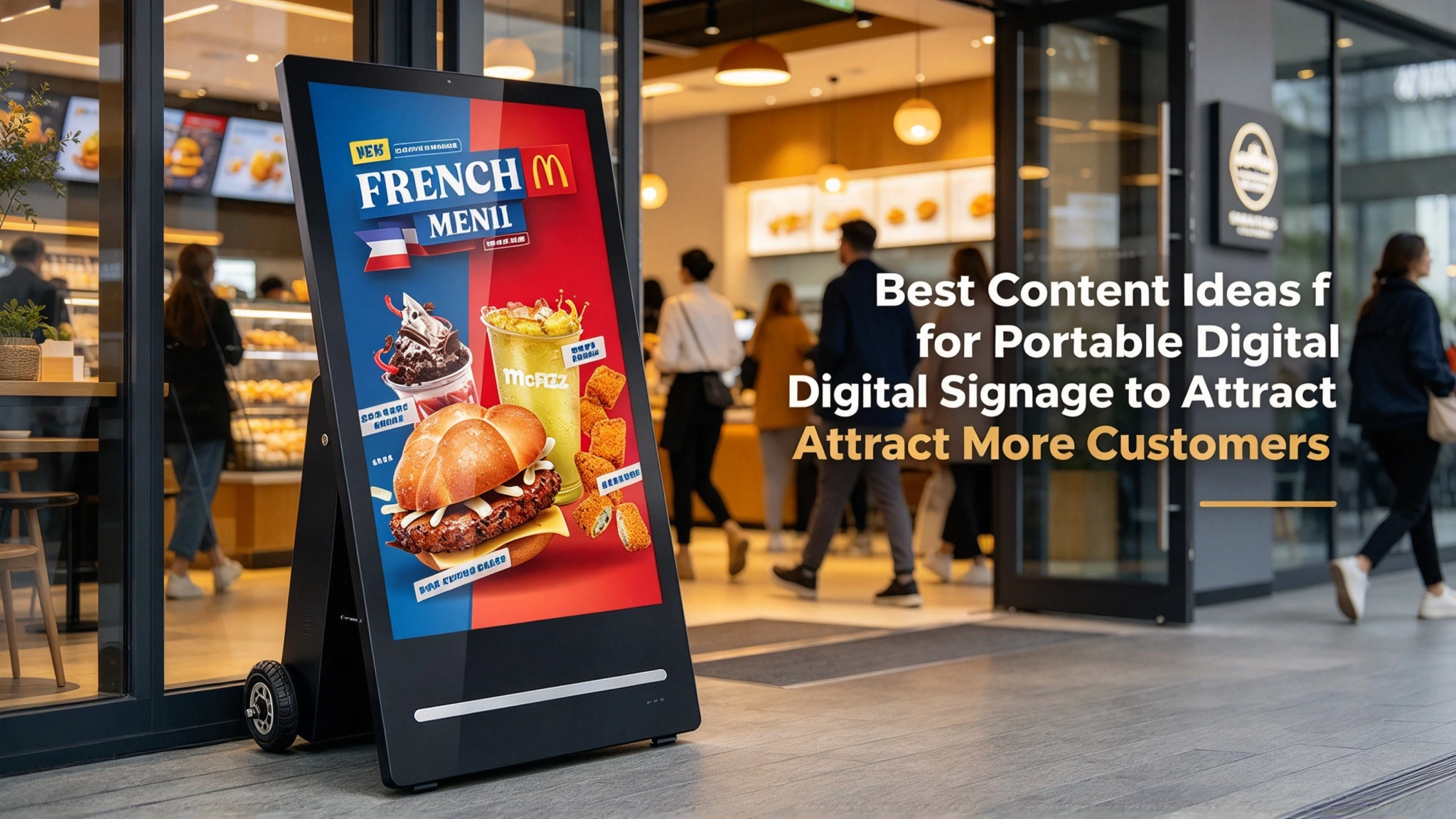
In today’s fiercely competitive business environment, portable digital signage is becoming a powerful tool for capturing customer attention. Unlike traditional fixed installations, portable digital signage can be repositioned flexibly based on foot traffic changes, reaching target audiences at the critical moment. Studies show that approximately 80% of customers are more likely to enter a store after seeing an eye-catching digital display. This means that with the right content ideas, portable digital signage can become an efficient customer acquisition tool.
Why Portable Digital Signage Needs a Dedicated Content Strategy
The use cases for portable digital signage differ fundamentally from traditional fixed screens. Whether at a pop-up store, trade show, or temporary promotion, viewers are often on the move, with extremely limited time to focus on the screen. Industry experts recommend that content for portable displays follow a “three-tier information architecture”: distant information uses a single point and strong contrast to grab attention, mid-range information conveys product benefits or directional guidance, and close-range information drives conversion through QR codes or calls to action.
This means that when designing content for portable digital signage, you should not cram a full brochure onto the screen. Instead, use large fonts, short loops, and ample dwell time to ensure every frame of information can be quickly understood.
Promotional Content: Creating Urgency and Instant Appeal
Promotional content is the most direct and effective application of portable digital signage. In retail environments, more than 80% of purchase decisions are made in-store, and promotional messages on eye-catching screens can significantly influence customer choices at the “moment of truth.”
Portable digital signage is particularly well-suited for displaying limited-time offers, flash sales, and bundle deals. You can use the screen to show countdown timers, “last chance” banners, or “only a few left” inventory alerts to create urgency. When customers see “offer ends today” or “limited supply,” they are more likely to act immediately rather than hesitate.
For outdoor deployments, content design must also account for the challenges of ambient light. A high-brightness portable outdoor display typically requires 1000 cd/m² or higher to remain readable in direct sunlight. Therefore, outdoor promotional content should use high-contrast color schemes and bold fonts, avoiding overly delicate gradients and low-contrast elements.
Interactive Experiences: Turning Bystanders into Participants
Interactive content is a unique advantage of portable digital signage, especially for models equipped with touchscreens. When a screen features capacitive touch functionality, you can design richer interactive experiences to extend customer dwell time and deepen brand impressions.
QR code interactions are a low-cost, high-return choice. Display a QR code on the screen to guide customers to scan for coupons, enter giveaways, or view product details. This approach connects the physical screen with the customer’s phone, extending the experience from the display into the customer’s hands. In dining scenarios, this strategy is especially effective—after scanning, customers can continue browsing the full menu or complete their order on their own device.
For trade shows and events, a versatile portable indoor display can support gamified interactions. Simple touch-based games—such as price guessing, product knowledge quizzes, or lucky draws—can attract crowds and create a natural traffic-driving effect for your booth. The key is to ensure interactions are simple and intuitive; the fewer the steps, the higher the participation rate.
Contextual Content: Making Information Resonate with the Environment
The greatest advantage of portable digital signage is its “portability”—you can adjust content in real time based on time, location, and audience characteristics. This flexibility creates unique opportunities for contextual marketing.
Weather-triggered content is an effective way to boost relevance. Research indicates that weather is the second biggest factor influencing consumer behavior, after the economy. You can set the screen to automatically switch content based on real-time weather: promote hot drinks during rain, showcase cold beverages and sunscreen in high heat, and display allergy medication for pharmacies during pollen season. Some systems even support temperature threshold triggers, automatically playing specific ads when the temperature exceeds a set value.
Time-based content is equally important. A café can display breakfast specials in the morning, shift to desserts and specialty coffee in the afternoon, and switch to light dinner recommendations in the evening. This “dayparting” strategy ensures that screen content always stays in sync with customers’ immediate needs.
Visual Design Essentials: Making Content Grab Attention in an Instant
Content for portable digital signage must be designed for “quick browsing,” which is fundamentally different from traditional posters or web pages.
Fonts and contrast are the first threshold. A font size of 20-30 points is recommended to ensure long-distance readability, while retaining about 40% white space to avoid visual clutter. Studies show that digital menu boards receive 400% more gaze time than static displays, but this advantage only materializes when content is clearly legible.
Restrained use of motion elements is equally critical. Motion does attract attention—the brain processes images about 60,000 times faster than text—but excessive animation reduces readability and causes visual fatigue. Best practice is to use smooth transitions and precise animations rather than dazzling effects. Each video loop should be kept to 6-12 seconds, ensuring that no matter when a customer looks at the screen, they can quickly grasp the core message.
Real-Time Updates and Offline Reliability
Content strategy for portable digital signage should also address connectivity. Network connections at trade shows and temporary event venues are often unstable, and shared Wi-Fi may experience delays or even outages during peak hours.
For this reason, it is advisable to prepare offline content backups for portable displays. Preload the complete content loop into the device’s internal storage so that even if the network goes down, the screen continues playing and avoids an awkward “black screen.” At the same time, complete all content updates before the event begins rather than making last-minute adjustments during open hours, minimizing technical risk.
For users of Sundek’s portable displays, you can fully leverage the device’s local storage capabilities, making core promotional content and interactive features available offline, with the network used only for optional data syncing and remote monitoring.
Conclusion
The value of portable digital signage lies not in the screen itself, but in whether the content it displays can touch the right people at the right time and in the right place. Whether it is a limited-time promotion that creates urgency, an interactive experience that invites participation, or contextual information that resonates with the environment, successful content ideas always revolve around one core principle: turn every glance into action.
When your portable display can flexibly adjust information based on foot traffic, weather, and time of day, it is no longer just a screen—it becomes a tireless sales assistant, continuously attracting customers and driving conversions for you.