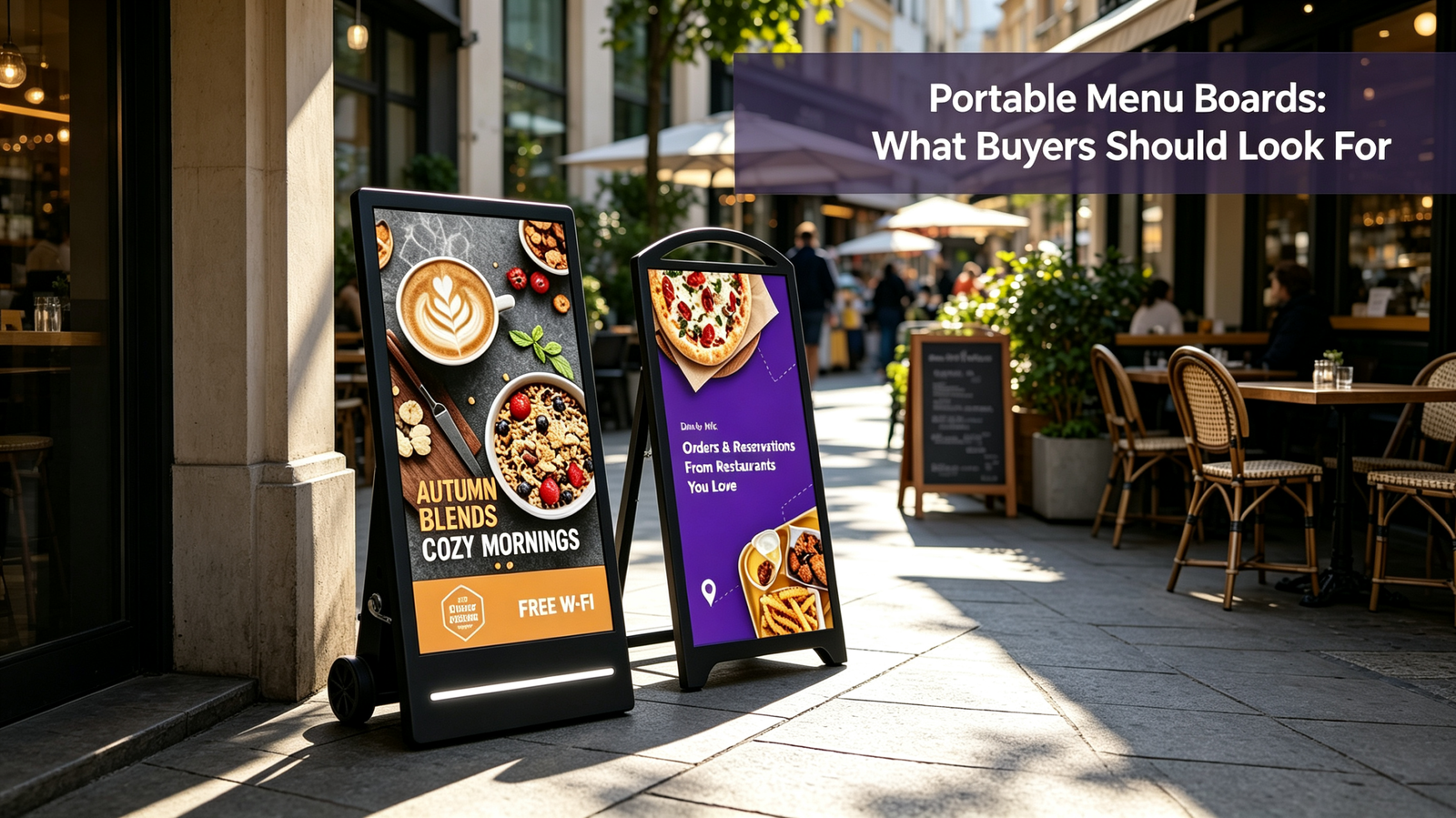
A portable menu board is one of the most practical investments a restaurant, café, or food truck can make. It is a display solution that can be moved, repositioned, and set up without professional installation. Unlike permanent wall-mounted signage, portable menu boards allow operators to adapt to changing environments—whether that means displaying daily specials on a sidewalk, setting up a temporary ordering station at an event, or simply refreshing the visual presence of a storefront.
However, the term “portable menu board” covers an enormous range of products. Prices vary from a few dollars for a simple insert to several hundred dollars for rechargeable LED systems. The key is to understand the factors that separate a reliable long-term asset from a short-lived convenience.
This article breaks down the essential considerations for buyers evaluating portable menu boards, with attention to both indoor and outdoor use cases.
Understanding Your Environment: Indoor vs. Outdoor
The single most important question before any purchase is: Where will this board primarily live?
Indoor menu boards face minimal environmental stress. They deal with ambient lighting, occasional moisture from spills, and the wear of daily handling. The primary concerns are aesthetics, readability, and how well the board integrates with the venue’s interior design. A lightweight foam board or an elegant acrylic stand may be entirely sufficient.
Outdoor menu boards operate under an entirely different set of rules. They are exposed to wind, rain, UV radiation, temperature fluctuations, and the risk of theft or accidental damage. The material must be weather-resistant, the base must be stable enough to resist gusts, and the graphics must not fade within weeks of sun exposure. A board that works beautifully indoors may fail catastrophically after a single stormy afternoon outside.
Material Matters: What the Board Is Made Of
The material of the board—often called the substrate—directly determines durability, weight, and cost. Here is a practical breakdown of common options.
Foam Board is the lightest and most economical choice. It is ideal for indoor use, temporary promotions, and situations where the board will be handled gently. Its weakness is moisture: even brief exposure to rain can warp or damage the surface. For outdoor use, foam is rarely the right answer.
PVC Board (often referred to as Sintra) offers a significant upgrade in durability. It is rigid, smooth-surfaced, and resistant to weather, making it suitable for both indoor and outdoor applications. PVC handles rain and sun well and can be cut into custom shapes. It is heavier than foam but remains portable. For most mixed-use scenarios, PVC represents a reasonable sweet spot between cost and longevity.
Aluminum Composite Material (ACM) is the premium choice for long-term outdoor installations. It is dimensionally stable, will not rust, and maintains a professional appearance over years of exposure. The trade-off is cost: aluminum is the most expensive of the common substrate options.
Acrylic appears frequently in modern LED menu boards and tabletop displays. It offers a glass-like clarity that can make backlit graphics look striking. However, acrylic is heavier and more brittle than PVC, and it requires careful handling.
Weather Resistance and Stability: The Outdoor Imperatives
For outdoor use, two factors matter above all else: wind resistance and water protection.
A menu board that tips over in a moderate breeze is not merely a nuisance—it is a safety hazard and a lost marketing opportunity. Stable outdoor boards typically rely on one of several mechanisms: weighted bases (sometimes fillable with water or sand), ground spikes for soft terrain, or a wide A-frame geometry that distributes force.
A-Frame designs are particularly common for sidewalk menus. A well-constructed A-frame with solid hinges and a heavy frame can remain upright in conditions that would flatten a lightweight insert. When evaluating an A-frame, look for reinforced hinges, a chain or latch mechanism that prevents overextension, and a frame material that can withstand repeated folding without loosening.
For printed graphics, UV-resistant inks and waterproof panel surfaces are non-negotiable for outdoor deployment. Vinyl banners and PVC panels generally perform well; standard paper or untreated cardstock will not survive.
Portability vs. Stability: Finding the Balance
Portability and stability exist in tension. The lightest boards are easiest to move but most vulnerable to wind. The heaviest boards stay put but become a chore to reposition.
The right balance depends on usage patterns. A food truck that sets up and breaks down daily needs a board that folds flat, carries easily, and sets up in under a minute. A café that places a sidewalk sign each morning and brings it in at night can tolerate a heavier base in exchange for greater wind resistance .
Many portable menu boards now incorporate rechargeable batteries for LED illumination. This feature eliminates the need for power outlets, which is valuable for outdoor events or locations without accessible electricity. A runtime of 10–12 hours per charge is typical for quality LED systems . Buyers should verify the battery specifications, as lower-quality units may claim impressive numbers that degrade quickly.
Updateability: How Easily Can the Menu Change?
A menu is a living document. Seasonal items, price adjustments, and daily specials mean the board’s content will change more often than many buyers anticipate.
The most flexible systems use interchangeable panels, magnetic strips, or slide-in inserts. These designs allow the operator to update specific items or sections without replacing the entire board. Chalkboard and dry-erase surfaces offer the ultimate flexibility but depend on consistent handwriting quality—a printed-look board may be preferable for venues without a skilled letterer.
For LED and illuminated boards, content updates often involve rotating acrylic panels or digital displays. Digital options offer the greatest flexibility but introduce electricity dependency, higher upfront cost, and the risk of technical failure .
Design and Readability: The Overlooked Factors
A menu board’s primary function is communication. Design decisions that seem minor can have outsized effects on how quickly and comfortably customers absorb information.
Contrast matters more than color. High-contrast text (dark on light or light on dark) reads faster than subtle color combinations, especially at a distance or in outdoor glare. Font size should be generous enough for a customer to read from several feet away without squinting. The number of items displayed should be limited: excessive choices create decision fatigue and slow the ordering process -8-14.
For outdoor boards, consider the angle of sunlight throughout the day. A glossy surface can create glare that obscures the menu entirely at certain hours. Matte or satin finishes are often more practical for outdoor readability.
Cost Considerations: What You Are Actually Paying For
Portable menu boards span a wide price range. At the low end, a basic A-frame with printed inserts may cost under $50. At the high end, rechargeable LED systems with rotating panels and premium materials can exceed several hundred dollars.
The relevant question is not which board is cheapest, but which board offers the lowest total cost over its useful life. A $40 foam board that must be replaced every few months may cost more than a $150 PVC board that lasts for years. Similarly, an outdoor board that fails in wind and damages property represents a cost far beyond its purchase price.
For buyers evaluating products, seeking out suppliers with clear specifications and verified customer feedback is essential. Platforms like Alibaba provide supplier ratings and transaction histories that can help distinguish reliable manufacturers from those with inconsistent quality records .
Final Recommendations by Use Case
Indoor tabletop or counter displays: Lightweight acrylic or PVC stands with clear, high-contrast graphics. LED backlighting can add visual appeal in dim venues.
Sidewalk and storefront A-frames: Solid wood or metal frames with weather-resistant panels. Prioritize hinge quality and base stability over decorative flourishes .
Outdoor event and food truck boards: Foldable designs with carry bags, UV-resistant printing, and weighted bases. Rechargeable LED models eliminate power constraints .
Multi-location or frequently updated menus: Interchangeable panel systems or digital displays reduce long-term update costs, though digital options carry higher initial investment and maintenance requirements .
For a closer look at portable menu board options suitable for both indoor and outdoor deployment, explore the product range at Sundek Display. The right board is not the most expensive one—it is the one that matches your environment, your update frequency, and your tolerance for maintenance.