
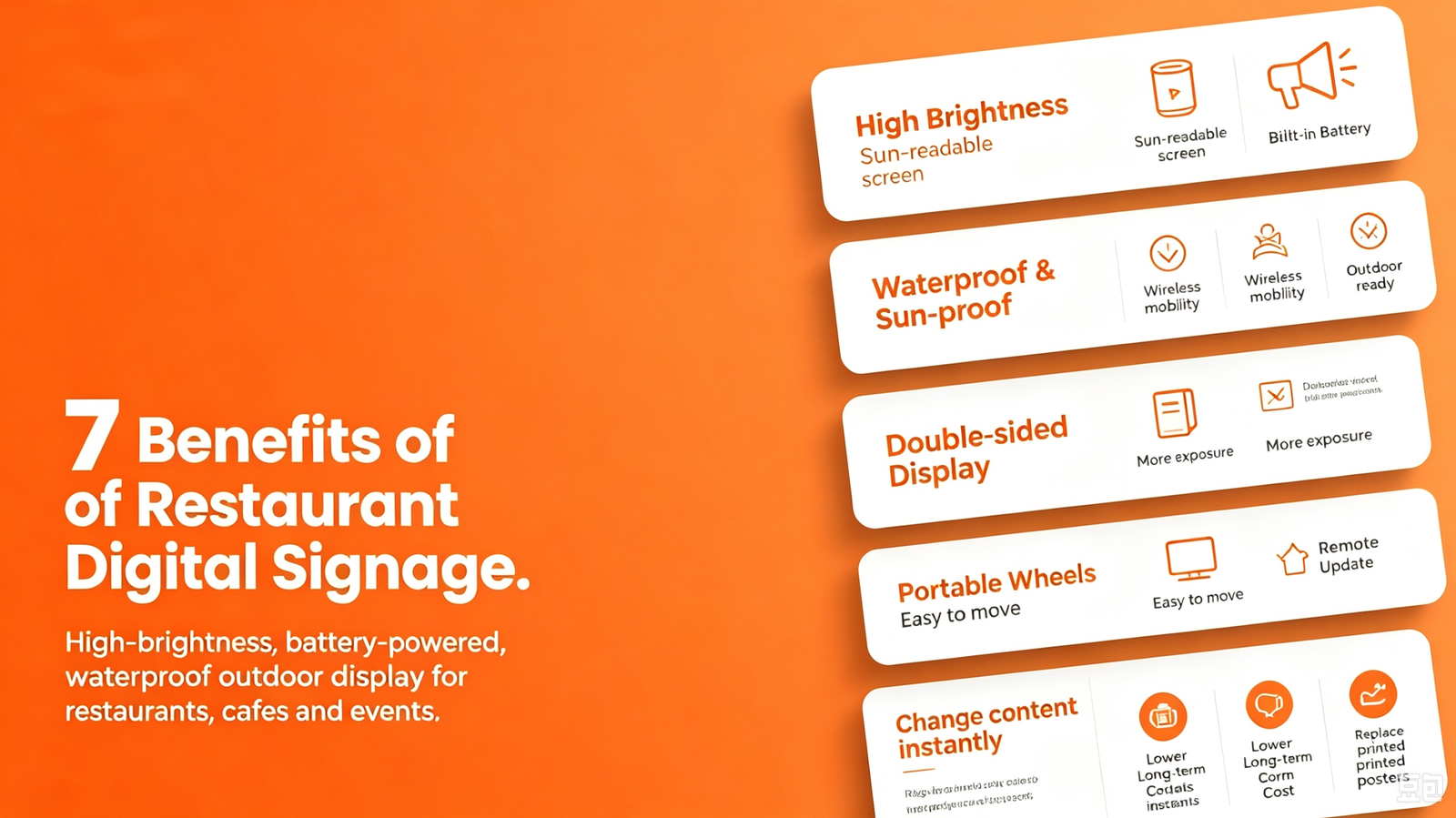
When you walk into a fast-food restaurant, would you rather look at a static plastic menu board, or a dynamic digital screen showcasing mouth-watering food visuals with clearly marked prices and promotions? The answer is obvious.
More and more restaurants are replacing traditional static menus with digital signage. And data proves this isn’t just a trend — it’s a strategic investment that delivers measurable revenue growth and operational efficiency. Over 80% of restaurant owners report increased order volume after adopting digital signage.
Here are 7 core benefits of digital signage for restaurants:
1. Higher Average Check Size & Sales Revenue
Digital signage directly influences customer purchasing decisions. Studies show that 68% of customers say digital screens make them more likely to purchase the advertised items. Dynamic displays of dessert recommendations, drink pairings, and limited-time add-on offers effectively encourage customers to order more than their main meal.
Real-world results: A fast-food chain increased average check size by 23% through digital signage promotions. Another European QSR brand, Panos, boosted beverage sales by over 7% after deploying digital signage.
Why it works: High-definition motion visuals stimulate appetite far more effectively than static text. When customers see tempting food imagery while waiting in line, they’re more prone to impulse purchases. Digital menu boards influence purchase decisions for 29.5% of customers.
2. Lower Menu Update Costs & Eliminate Printing Expenses
Every static menu update — price adjustments, new product launches, or promotional changes — requires design, printing, distribution, and manual replacement. It’s time-consuming and expensive.
Digital signage makes menu updates nearly free and instant. Change a few words in the backend, and every store screen updates simultaneously.
Cost comparison:
| Cost Item | Static Menus | Digital Menus |
|---|---|---|
| Cost per update | Thousands of dollars (design + printing) | Near zero (backend operation) |
| Updates per year | 4-8 times (limited by cost) | Unlimited, change anytime |
| Annual savings for 250 locations | — | ~$2.5 million |
A Samsung white paper found that upgrading from static menu boards to digital menu boards saves a 250-location restaurant chain approximately $2.5 million in printing and maintenance costs in the first year alone.
3. Faster Ordering & Higher Table Turnover
In the fast-food industry, speed is everything. Digital signage allows customers to make decisions while waiting in line, so they’re ready to order immediately when they reach the counter — significantly reducing ordering time.
Real results:
- Restaurants with digital menu boards report 20-30% faster average order times, with peak-hour table turnover increasing 15-20%
- Digital signage reduces customers’ perceived wait time by up to 35%
- QSR industry data shows dynamic menu boards improve decision speed by 15-20% and increase average check size by 12-18%
Why it speeds things up: Clear, dynamic menus help customers make quick choices, reducing hesitation and the need to ask staff questions. 73% of customers say restaurant technology enhances their dining experience.
4. Dayparting — Show the Right Menu at the Right Time
One static menu board can’t show breakfast in the morning, lunch at noon, and dinner at night. But digital signage can.
Digital menu boards support automated dayparting:
- 10:30 AM — automatically switches from breakfast to lunch menu
- 10:00 PM — automatically displays late-night specials
- Hot weather — automatically promotes cold drinks; cold weather — promotes hot coffee
This kind of precision ensures customers always see the most relevant items at every moment. Dayparting combined with digital signage can drive up to 20% sales lift.
5. Real-Time Inventory Sync — Eliminate Customer Disappointment
Ever ordered something only to be told “we’re out of that” right after? It’s a terrible customer experience that erodes trust.
Digital signage can integrate with your POS or inventory system. When a certain ingredient is running low, the screen automatically removes that item — preventing customers from ordering unavailable items in the first place.
This reduces customer frustration and decision anxiety while building trust — customers perceive your restaurant as reliable and up-to-date.
6. Stronger Brand Experience & Atmosphere
Digital signage is more than a menu board — it’s a brand experience amplifier.
- Showcase food details in 4K ultra-high-definition to stimulate appetite
- Play brand videos simultaneously to communicate brand identity
- Create immersive atmospheres with multi-screen displays (e.g., sports bars showing live games)
- Entertain waiting customers with engaging content, reducing perceived wait time
McDonald’s has been consistently using digital signage to create brand atmosphere, replacing traditional static posters with dynamic multimedia content to enhance the immersive dining experience across its global locations.
7. Data-Driven Decision Making
Digital signage isn’t just a display tool — it’s a data collection gateway.
- Self-service kiosks track customer click behavior, revealing which items are most popular
- Backend systems analyze time-based sales data to optimize menu layouts and promotional strategies
- Multi-location brands can compare performance across stores, identify best practices, and scale them
“Digital signage shouldn’t just be a display tool. Restaurants that show the right content to the right customer at the right time are the real winners,” says industry expert. During the 90-second menu browsing window, restaurants that display contextually relevant content based on time of day, weather, or local events are best positioned to convert browsers into buyers.
Summary: Digital Signage Is an Investment, Not a Cost
Data shows that while the initial investment in digital signage is higher than static menus, over a five-year period, each location saves approximately $10,000 in total costs (printing, labor, maintenance) — and that’s before accounting for incremental revenue from sales lift.
For restaurants, the core value of digital signage is clear: save printing costs, increase check sizes, improve table turnover, eliminate customer disappointment, and strengthen brand perception.
FAQ — Quick Answers for Restaurant Owners
Q: Do I need a professional to install digital signage?
A: It depends. For basic wall-mounted installation with cloud-based content management, most digital signage solutions are DIY-friendly. For POS integration, multi-screen splicing, or outdoor installations (requiring weatherproofing and temperature control), professional integrators are recommended.
Q: How long does it take to see ROI from digital signage?
A: Typically 6-12 months. QSR industry case studies show that well-deployed solutions reach breakeven within 7 months, and save approximately $10,000 per location over five years in operating costs.
Q: How long does digital signage hardware last?
A: Commercial-grade digital signage is designed for 24/7 continuous operation, with an industrial lifespan of 50,000+ hours (approximately 5-6 years of non-stop use).
Q: Is digital signage worth it for small restaurants?
A: Absolutely. Even a single screen saves printing costs, enables dayparting, and drives higher check sizes through compelling visuals. LED screens add only a few dollars to monthly electricity bills — highly cost-effective compared to printing savings and revenue lift.
Q: Can digital signage integrate with my POS system?
A: Yes. Leading digital signage solutions support POS integration for inventory auto-sync (automatically remove out-of-stock items) and real-time sales analytics.
Want to learn more about choosing the right digital signage for your restaurant? (https://sundekdisplay.com/product/) [Contact Us] (https://sundekdisplay.com/https-sundekdisplay-com-contact-sundek-display/) for a customized solution.